Asset Inventory for BPOs: A Security Control, Not a Storage Problem
Most BPOs treat asset inventory as a logistics chore: where's the laptop, who has the headset. Treat it as a security control instead, and the question becomes the one auditors and privacy regulators actually ask: can you prove, in minutes, where every data-bearing device is, and that the ones you retired were wiped? A device you can't account for isn't a hardware write-off. It's a breach-notification event.

Sami Akhtar
Security & Compliance Advisor, FrontLine · Published June 17, 2026
An agent resigns on a Friday. By Wednesday, HR has closed the file, payroll is settled, and the access review is done. Six weeks later, a client security questionnaire asks a routine question: confirm that every asset issued to terminated staff has been recovered and sanitised. Someone opens the asset spreadsheet. It shows a laptop issued to that agent eighteen months ago, and nothing since. No return date, no condition, no disposal record. Is it in a drawer? Did it go home and never come back? Was it quietly reissued to someone else? Nobody can say. That one blank cell is now three problems at once: a possible data-breach exposure, a failed control in front of a client, and an asset register that's been wrong for a year and a half. This is what it looks like when a BPO (Business Process Outsourcing: a firm that runs contact-centre operations on behalf of other brands.) runs inventory as a storage problem instead of a security control. The fix isn't a tidier spreadsheet. It's a handful of principles that make 'we don't know where it is' structurally impossible.
A BPO's laptops are a breach surface
Start with what a BPO actually hands out: laptops, sometimes phones, headsets, security keys, the occasional payment terminal. Most of those devices can reach client systems and hold client data, whether that's customer records, card numbers, or health information. You issue them to a workforce that turns over faster than almost any other industry, often working from home across several cities. Every device is a place client data can live, and a place it can walk out the door.
Security people already have a name for this. It's your attack surface, and for a BPO a large part of it is physical: the device in someone's bag. The classic causes of a reportable breach aren't all sophisticated intrusions. A big share is mundane: a lost laptop, a stolen phone, a drive recycled without being wiped, a device nobody recovered when its holder left. Lose track of the hardware and you've lost track of the data on it.
So asset inventory isn't a logistics function that happens to report to facilities. It's a security control, and it should be run like one. What follows are the principles that turn it into a control instead of a spreadsheet.
Chain of custody beats a current-holder field
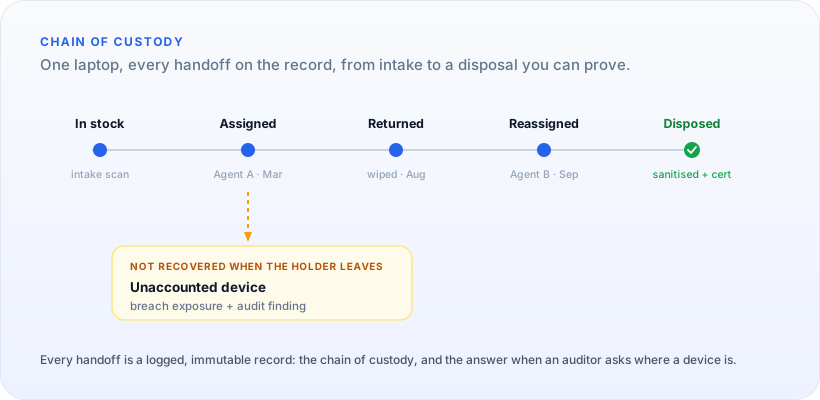
The most common way to track assets is one row per device with a 'current holder' column. Someone gets a laptop, you type their name in the cell. They hand it back, you blank the cell or type the next name. It feels fine. It quietly destroys the one thing you actually need, which is history.
The security question is never just 'who has it now.' It's 'who has had it, and when did it change hands.' When a drive turns up with data on it, or a client asks who could have reached a record back in March, a current-holder field can't answer. It only knows the present, and it's been overwritten every time the device moved.
Track assignments as a ledger instead. Every issue and every return is its own dated, immutable row: this device, to this person, on this date, returned on that date, in this condition. The current holder is simply the latest open entry. Nothing gets overwritten, so the chain of custody is always reconstructable. That ledger is the difference between 'we think Priya had it' and 'here is exactly who held it, start to finish.'
A lifecycle is a state machine, not a status column
Ask most operators what state a given asset is in and you'll get free text someone typed: 'with IT,' 'broken?,' 'in the Halifax office, maybe.' Free text is where accountability goes to die. An asset should only ever be in one of a small set of defined states, and it should only move between them in defined ways.
A workable set: in stock, reserved, assigned, in transit, in maintenance, returned, retired, disposed. Every device sits in exactly one of these at all times. Moving between them is an event you record, not a cell you edit. Received from the vendor, it's in stock. Issued, it's assigned. Shipped to a remote agent, it's in transit until delivery is confirmed. The exact list matters less than the rule: the states are finite, and every transition is logged.
Then there's the state nobody likes to name: lost. The real value of a state machine is that 'lost' or 'unaccounted' becomes an explicit state you can count, report, and act on, instead of a silent gap between two stale rows. If a device hasn't moved or been seen within a defined window, the system should say so out loud. A lost device you know about is an incident you can manage. A lost device you don't know about is the one that surfaces in a breach notification.
Offboarding has to close the asset loop
If there's a single moment where BPO asset control breaks, it's the exit. Someone leaves, and in the rush of final pay, access revocation, and backfilling the seat, the laptop on their kitchen table becomes nobody's job. Multiply that by the turnover a BPO runs and you have a steady leak of data-bearing devices into the world, each one still holding whatever its last user touched.
Recovery can't be a separate checklist somebody might remember. It has to be wired into offboarding so the workflow itself won't close while an asset is still open. The moment a termination is logged, every open assignment for that person should surface as a task with an owner and a due date: recover the device, confirm it was wiped, or file a documented exception that explains why it can't be. 'The employee is gone' is not a resolution. 'Device recovered and sanitised on this date' is one. 'Written off with sign-off because it was a bring-your-own-device stipend' is another.
Done this way, the exit ends one of two ways: with every device accounted for, or with a deliberate, signed decision about the ones that aren't. What it never ends with is a blank cell and a shrug.
Data-bearing assets get a higher bar
Not every asset carries the same risk. A spare headset going missing is a petty-cash problem. A laptop going missing is potentially a breach-notification event under PIPEDA or under a client's contract. Your inventory should know the difference, because the response is completely different.
Flag the assets that store or can reach sensitive data. When one of those goes missing, the next step isn't 'order a replacement.' It's 'open an incident': what was on it, was the disk encrypted, who do we have to notify, and on what clock. Treating a lost laptop as a procurement event instead of a security event is exactly how a manageable incident becomes a regulator's finding.
Disposal is the other half of this, and it's the half everyone forgets. A drive leaving your control at end of life is every bit as sensitive as one leaving in someone's bag. Retiring a data-bearing asset isn't dropping it on the recycling pile. It's sanitising the media to a recognised standard like NIST 800-88, recording that you did it, and keeping the certificate. Make disposal a terminal, one-way state the system won't let you reach without that compliance reference attached. 'I'm pretty sure we recycled it' is not a record. A signed certificate of destruction is.
The audit trail is the control
Every principle above throws off the same by-product: a complete, immutable record of every asset and every hand it passed through. That record isn't paperwork wrapped around the control. It is the control.
Here's the test. A client security questionnaire, a SOC 2 auditor, or a privacy regulator asks a version of the same question: show me where every data-bearing device is, who holds it, and prove the ones you retired were sanitised. If answering means a week of chasing people and rebuilding history out of old emails, you don't have a control, you have a story. If it's a report you can run in minutes, you have a control, and you'll pass.
This is the same bar the rest of compliance runs on. SOC 2 Type II doesn't ask whether a policy exists; it asks whether the control operated, consistently, with evidence to show for it. Asset management is no different. The log is the evidence.
What changes when you get this right
Run inventory as a security control and the practical wins land first. Audits and security questionnaires stop being fire drills, because the answers already live in the system. Lost devices show up as managed incidents instead of breach notifications. The asset register stops drifting, so the numbers you hand to finance and to clients are actually true.
The deeper change is cultural. Once every device has a chain of custody and every exit closes the loop, 'we don't know where it is' stops being a sentence anyone is allowed to say. That's the whole point. A BPO lives or dies on whether clients trust it with their data, and few things burn that trust faster than not being able to say where the data-bearing hardware went. Treat inventory like the security control it always was, and a quiet liability turns into one more reason a client can trust you with the work.
Sources
This is an operator's argument grounded in established security and privacy practice, not a standard in its own right. Authoritative references below; where a point reflects common practice rather than a published rule, it's labelled that way.
Secure disposal. NIST Special Publication 800-88 Rev. 1: Guidelines for Media Sanitization . The widely-used reference for clearing, purging, and destroying data-bearing media, and for documenting that it was done.
Breach notification (Canada). Office of the Privacy Commissioner of Canada: privacy breaches at your business . Mandatory reporting of breaches of security safeguards that pose a real risk of significant harm has been in force federally since November 1, 2018.
Asset management as a security control. ISO/IEC 27001:2022 . Annex A treats inventory of assets, handling of storage media, and secure disposal as explicit information-security controls. The idea that asset control is security control isn't novel; it's written into the framework.
Lost and stolen devices as a breach cause. The role of lost, stolen, and improperly disposed devices in reportable breaches is documented year over year in industry breach studies, including IBM's Cost of a Data Breach report and the Verizon Data Breach Investigations Report. The exact share varies by report and year, which is why no single figure is cited here.
This article is not legal advice. Your specific obligations under PIPEDA, Quebec's Law 25, PCI DSS, or a given client contract depend on your operation and should be assessed with qualified counsel or your auditor.
Sami Akhtar
Security & Compliance Advisor, FrontLine
Security and compliance specialist with deep experience helping contact centres navigate PCI DSS, SOC 2, and cross-border privacy regimes. Writes the FrontLine compliance series.