The Multi-Client Architecture Problem
Generic workforce software assumes the company that buys it runs one business. BPOs don't. The structural mismatch between single-employer software and multi-client operations cascades into attrition, billing accuracy, QA consistency, forecasting, compliance, and knowledge loss, and integration doesn't fix it. A name for the problem most BPO software pretends doesn't exist.

Serge Belov
Founder, FrontLine · Published May 8, 2026
The first time I sat in a BPO (Business Process Outsourcing: a firm that runs contact-centre operations on behalf of other brands.)'s monthly billing reconciliation, I was thirty-two and assumed everyone in the room was being dramatic. Three people had blocked a Tuesday afternoon. There were four CSV exports on the shared screen: one from the time-tracking system, one from the WFM (Workforce Management: forecasting, scheduling, and adherence.) tool, one from the HR roster, one from the client's own portal. The question was simple. How many billable agent-hours did each of their seven clients owe them for the previous month?
The answer required joining the four CSVs by agent name, then by client code, then resolving the agents who had moved between client accounts mid-month, then handling the two agents whose time had been logged against the wrong client because the supervisor who normally caught that had been on vacation. Four hours in, they had a number for six of the seven clients. The seventh, the largest one, got a placeholder pending a follow-up call to a client manager. The invoice went out three days late.
The BPO was running a tier-1 WFM platform that cost six figures a year, and a separate tier-1 HRIS, and a time-tracking layer the company had built in-house years earlier because no commercial tool could handle the cross-client splits. None of it was the wrong software. All of it was wrong-shaped.
The reason that meeting took four hours wasn't operational sloppiness. It was that none of the tools in the stack could natively represent the thing the BPO actually was: a single workforce splitting its time across seven concurrent customer relationships, each with its own commercial terms. The systems each knew one slice. The reconciliation was where the slices had to be joined, and the joining was someone's Tuesday afternoon every month, forever.
This is the multi-client architecture problem. In the billing meeting it looks like a billing problem. HR sees it as attrition. WFM logs it as forecasting drift. It is one structural mismatch, viewed from six different rooms, and it is costing BPOs more than any line item on their P&L (Profit and loss: the statement of a business's revenue and costs.).
Naming the problem
Most workforce software sold to BPOs is built to serve many customers from a single system, with each customer's data kept safely separated from every other's. That's table stakes. By 2026, every platform you'd seriously evaluate clears that bar. Almost none clear the next bar up.
A retailer that buys workforce software is one customer with one workforce. A BPO that buys the same software is one customer with many concurrent end-client relationships, and a workforce that splits its time across all of them. The same agent who answers calls for Client A in the morning is on Client B in the afternoon. A supervisor watches a pod working three different clients on three different scorecards. And the schedule underneath has to respect every client's quality standards, language requirements, and access restrictions at once.
The platform's view of "one customer" is the BPO. The BPO's view of its own day is many clients, with dozens of lines of business beneath them. Those two views are not the same shape.
Call this the multi-client architecture problem. It has three layers: the platform's customer (the BPO itself; the vendor sees one paying customer per BPO); the BPO's clients (each of the businesses the BPO is contracted to support, each with its own commercial terms, scorecards, queues, and compliance rules); and lines of business inside each client (English vs. French support, billing vs. technical, tier-1 vs. tier-2 escalations, each typically with its own staffing model, supervisors, and quality standards).
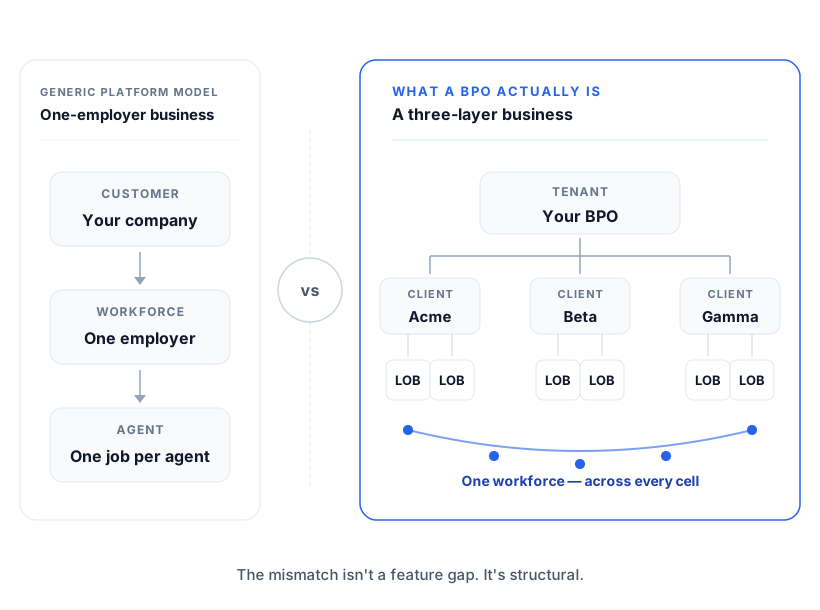
Generic workforce software handles the first layer well. It treats the BPO as a single customer and keeps that customer's data safely separated from every other paying customer on the platform. That's the bar everyone clears.
Almost no platform handles layers 2 and 3 at the same level of rigor. Inside the BPO's view, "client" is usually a label attached to a shift or a report, not a structural fact the system uses to enforce who works for whom, who sees what, and how anything gets billed. The same applies to lines of business. The system can be configured to model them, but the modeling is left to whoever installs the platform, the enforcement is left to whoever last touched the access rules, and rolling things up across clients is left to whoever owns the monthly reconciliation spreadsheet.
A platform that treats client and line of business as decorations on top of a single-customer model isn't badly coded. It's wrong-shaped for a BPO. The same software that works cleanly for a 5,000-person retailer with one HR system and one scorecard breaks subtly on a 500-agent BPO with seven clients and twenty-three lines of business. The breakage doesn't show up as crashes. It shows up as the reconciliation work in the opener. As the supervisor who keeps a private spreadsheet of which agent is allowed to take which client's calls because the system won't enforce it. As the QA (Quality Assurance: the program that scores and reviews agent interactions.) evaluator who runs two scorecards in two tools because the platform can only apply one at a time.
The multi-client architecture problem is the gap between what generic workforce software was built to model and what BPOs actually are. The rest of this essay is what happens when that gap stays open.
Where the mismatch comes from
The mismatch isn't accidental. It comes from where the software came from.
Most of the workforce platforms a BPO is shown today are evolutions of software originally built for a different kind of company. The platforms that dominate the category trace back to call-routing and quality-monitoring tools built in the 1980s and 1990s for in-house corporate contact centres. The customer was a bank, an airline, an insurer running their own service operation. The model the software assumed was simple: one employer, one workforce, one set of products to support, one scorecard, one set of compliance rules, one payroll.
That assumption baked itself into every layer of the product. An employee record carried one job title and one department. Each schedule belonged to a single queue. Quality scorecards had one weighting model and compliance settings applied uniformly across the whole company. The systems were excellent at what they were built for: helping a single large enterprise run its own contact centre efficiently.
When BPOs emerged as a category in the late 1990s and accelerated through the 2000s, they bought the same software. The vendors saw a new and growing customer segment and didn't want to lose it. So they added features. A "client" field appeared on the employee record. A "customer" tag could be attached to a queue. The reporting layer learned how to filter by these new attributes. The promise to the BPO buyer was that the platform now supported their use case.
What the BPO buyer was actually being sold was the old single-employer model with the new attributes painted on top. The employee still had one official job, the BPO's. The schedule still belonged to one queue at a time. The scorecard was still applied one at a time per evaluation. The "client" field was descriptive metadata, not a structural constraint. The platform could tell you which client an interaction was for. It could not enforce that the agent was actually allowed to be working that client's calls, or compose a billing report that respected each client's commercial terms without manual joining, or apply different scorecards depending on which client the call belonged to.
The patches worked well enough to win the deal. They didn't work well enough to remove the manual layer underneath. The supervisor's private spreadsheet, the month-end reconciliation meeting, the QA evaluator running parallel scorecards; these weren't workarounds for missing features. They were the load-bearing layer the software couldn't carry.
Thirty years later, the patches have accumulated, the BPO customer base has grown, and the model underneath is still the one built for a single employer. The newest entrants, cloud-native platforms that matured through the 2010s, inherited the same data assumptions because that's what their target customer (enterprise contact centres) needed. The pattern hasn't been broken; it's been refreshed.
This is why the multi-client architecture problem hasn't been solved. The problem isn't invisible. It's been on every BPO's RFP wish-list for a decade. But solving it requires rebuilding the data model from underneath, and rebuilding the data model is the kind of investment that's hard to justify against an existing book of business.
Six rooms in the building
What looks like six separate operational problems in a BPO is, structurally, the same problem viewed from six different rooms. The pattern repeats because the underlying data shape is the same. Here is what the gap costs.
Attrition
BPO attrition runs at 30–50% annually in North America, with chat and entry-level voice segments often substantially higher (ContactBabel, US Contact Center Decision-Makers' Guide, 2024 ). That is roughly three times the cross-occupation service-work baseline. Some portion of that is unaddressable by software (geography, life circumstance, a competitor's offer). A meaningful portion is not.
The agents who quit early are disproportionately the ones the system didn't quite see. The cross-client agent whose ramp curve was slower because the training material referenced procedures that only applied to one of her two clients. A night-shift agent whose adherence "miss" was actually the scheduling system failing to recognize a legitimate handoff between two LOB (Line of Business: a distinct client program or queue within an operation.)s. The new hire who slumped at week three with nobody flagging it, because no single dashboard rolled up her QA, training, and adherence into one view. In a multi-client setup, the signal that an agent is struggling lives in pieces scattered across every surface she works on, and most platforms don't join those pieces back together.
Industry-average replacement cost per hire runs around $5,500 fully loaded (SHRM Talent Acquisition Benchmark Report, 2024 ), with contact-center-specific roles typically falling in the $3,500–$7,500 range depending on geography and tenure expectations. For a 500-agent BPO with 40% annual attrition, that is roughly $700K–$1.5M a year, every year. If 20–30% of that is the kind of attrition a connected system catches (agents flagged at week three instead of discovered at week eight), the addressable portion runs $140K–$450K annually. That is the budget any platform purchase should be measured against, not the line-item price of the platform.
Billing accuracy
Billing accuracy is a quiet line item. It doesn't show up on the budget the COO defends. It shows up in the gap between booked revenue and collected revenue, and in the goodwill spent every quarter explaining to a client why an invoice arrived three days late or had to be re-issued.
Studies of contract management put the average value leakage at around 9% of revenue across industries (World Commerce & Contracting, 2024 benchmark ). BPOs sit at or above the typical service-firm leakage band because the underlying contract complexity is higher: different commercial terms per client, often per LOB, with shift premiums and SLA (Service Level Agreement: a contractual performance target, e.g. answering X% of calls within Y seconds.) bonuses layered on top.
The mechanism, in a multi-client setup with single-employer software underneath: agent time is logged against one of several possible client codes by a person who is sometimes the supervisor, sometimes the agent, sometimes a back-office reconciler. The system doesn't enforce the assignment because it can't natively model that the agent works for two clients at once. Errors aren't caught at entry; they're caught (or missed) at month-end, when somebody joins four CSVs in a meeting like the one in the opener.
For a $10M-revenue BPO, 5% leakage is $500K a year, net to the bottom line. That's not a software wish-list item. It's a margin line.
QA consistency
The QA tool the platform offers is excellent at evaluating one call against one scorecard. The trouble starts when the agent works for three clients and each client has its own scorecard, its own weighting of soft skills against compliance items, and its own definition of what constitutes a "fail" on the empathy criterion.
What happens in practice: the QA evaluator picks the primary client's scorecard, scores the call, then keeps a private spreadsheet of secondary scorecards for the other clients the agent supports. Or runs a second evaluation against a second scorecard manually. Or, most commonly, only evaluates calls for whichever client is currently asking the loudest. The official QA score in the platform represents one slice of the agent's actual performance. The real quality picture lives in the evaluator's head and her spreadsheet.
The consequence isn't just bad coaching. It's invisible variance. When Client B asks why their CSAT (Customer Satisfaction: a post-interaction score for how satisfied a customer was.) is drifting and the BPO points to its QA scores as evidence of consistent performance, the underlying data is structurally incomplete; the scores were calibrated to Client A's scorecard, not Client B's. Coaching priorities get set against the wrong benchmark, calibration sessions optimize for the wrong patterns, and Client B's quality concerns get filed as "we'll watch it" before resurfacing in the next quarterly business review as a tougher conversation.
Inconsistent quality is the most expensive thing a BPO can deliver, not because of immediate cost, but because client churn cycles are 12–24 months and the leading indicators are exactly the QA signals the platform can't see clearly.
Forecasting drift
A workforce forecast that can't decompose by client and LOB rolls up into an aggregate number that hides the variance the scheduler actually needs to staff for. The platform predicts 4,200 calls Tuesday morning. What it doesn't say is that 1,100 are Client A's billing queue (English-only), 800 are Client B's tech support (bilingual French/English required), 1,500 are Client C's tier-2 escalations (must hold the relevant Client C product certification), and 800 are spillover from a Monday backlog that was supposed to be Client A's but got mis-routed.
When the scheduler builds against the aggregate, the staffing looks fine. Tuesday morning arrives and Client B's bilingual queue is understaffed by six agents while Client A's English queue has seven extras nobody can re-task without a license that takes a week to grant. Adherence dashboards stay green; SLA dashboards turn red. The agents who can take Client A's calls watch the queue empty while Client B's customers hold.
Industry forecast accuracy benchmarks put best-in-class large agent groups at under 5% forecast variance at the aggregate level, with most operations running 5–15% (ICMI Guide to Contact Center Metrics ). The number is correct as far as it goes. The number that matters, accuracy of forecast against the right mix of agents, typically isn't measured because the platform can't measure it cleanly.
A 10% mix-error costs roughly the same as a 10% volume-error in dollars: overtime, missed SLAs, client credits. For a mid-size BPO, that's a recurring six-figure annual leak that's invisible to the platform's own reporting.
Compliance exposure
Different clients live under different regulatory regimes. The financial-services client demands SOC 2 Type II evidence and PCI-DSS scoping for any agent touching payment data. The healthcare client demands HIPAA controls and US-only data residency. The Quebec client falls under PIPEDA and Law 25; the California client falls under CCPA. The EU client (if there is one) layers GDPR over everything.
A workforce platform that applies one compliance posture per tenant has two bad options. Either it adopts the most restrictive client's standard and applies it across every other client's data (expensive and overscoped) or it doesn't, and lives with the gap between what each client contractually requires and what the platform can structurally guarantee.
In practice most BPOs do the second, and document around the gap. Manual processes get written into client-facing compliance attestations. A Google sheet lists which agents are PCI-cleared. A separate sheet lists which agents have completed HIPAA training within the last twelve months. The platform's official compliance dashboard reports "all green" while the real compliance posture lives in the sheets.
The cost shows up in three places: audit preparation time (weeks per cycle), client-driven RFP losses (when the BPO can't credibly attest to a specific control), and the catastrophic-risk tail (a privacy commissioner ruling, a class action, a client termination on a major contract). The first two are continuous. The third is rare and existential.
Knowledge retention
The senior agent who knows that Client A's exception process for express orders is different from what the runbook says is one of the most valuable people in the BPO. She is also a single point of failure. When she leaves (and at industry attrition rates, she will), the workaround leaves with her. The next agent who hits the same exception either re-discovers it the hard way or escalates to the supervisor who escalates to the client.
Workforce platforms typically don't carry knowledge management. Knowledge management is usually a separate tool: a client-specific knowledge base, or worse, the client's own knowledge base that the agent has to log into. The structural mismatch is that the agent's expertise is cross-client (she knows how to navigate ambiguity across all the clients she's worked) while the knowledge bases are per-client (each client's content lives in its own silo).
The tacit knowledge that an experienced agent accumulates (the workaround for Client A's broken returns flow, the specific phrase that calms down a particular type of Client B customer, the escalation path that actually gets things done at Client C) is the layer the BPO is most exposed on. None of it is captured anywhere, and it doesn't move with her even when she just changes shifts, let alone when she leaves.
Panopto's Workplace Knowledge and Productivity Report estimates the average large US business loses $47 million annually to inefficient knowledge sharing, with 42% of institutional knowledge held by individuals rather than by the systems they work in, and 81% of employees citing experience-based knowledge as the hardest to replace once the person who has it walks out the door. In a BPO with senior-agent attrition running at 20–30% annually, the cumulative loss is the largest unrecognized expense on the operations P&L.
The shape of the mismatch
These six cascades share a single root cause: workforce software built for a different kind of company, working as well as it can inside a BPO's actual shape. They are not signs of weak operations, vendor missteps, or under-investment in tooling. They are the shape of the mismatch, visible from six rooms in the building.
The economic weight is hard to total precisely, because the costs spread across budget lines that rarely get added together: HR turnover replacement, ops reconciliation hours, finance month-end leakage, compliance preparation cycles, institutional knowledge that walks out the door. Taken together, for a mid-size BPO, they sit in seven-figure territory annually. That is the frame worth carrying into the architectural conversation.
What integration can and can't fix
The most common response to the multi-client architecture problem, when it's named, is that integration will close the gap. Pipe the HRIS into the WFM, the WFM into the QA tool, the QA tool into the LMS, and the data shape will compose itself. The thinking is appealing. It is also incorrect, for three reasons.
Connection is not composition
What an integration does is move data from one system to another. What it cannot do is change the shape of the data once it arrives. If the HRIS thinks the agent has one job, the integration sends "one job" to the WFM, which receives "one job," which schedules against "one job," and produces a schedule the BPO then has to adjust manually because the agent actually works for two clients on alternating shifts.
The problem is not connectivity. The problem is that every system in the chain was designed with the same single-employer assumption, and an integration between two systems that share the same wrong assumption produces wrong-shaped data faster.
This shows up most clearly in the work that happens after the integration runs. The schedule the WFM produces is correct against its inputs. The inputs were correct against the HRIS. The HRIS was correct against what HR entered when the agent was hired. The output is still wrong, because the agent's actual job is the thing none of the systems can represent. A human has to step in at the end of the pipeline and apply the correction the data was supposed to carry through. The integration removed a few hours of manual data entry between the systems. It did not remove the underlying reconciliation work; it just changed where in the process the human has to do it.
Connection is not composition.
The integration tax
The work of joining data across systems is not free. For most BPOs, it is the largest unbudgeted line item in operations.
A typical 1,000-agent BPO operates somewhere between five and ten distinct systems that touch workforce data: an HRIS, a WFM platform, a QA tool, an LMS, payroll, a ticketing system, often a separate compliance tracker, sometimes a separate scheduling tool that sits in front of the WFM. Each system is a source of truth for one slice. Composing across them (answering "which agents are eligible for Client B's bilingual queue, have completed the new product training, and aren't already over their weekly hours cap?") requires joining data from at least four of those systems.
In practice, this joining happens in three places. Some of it lives in dedicated integration software, which is expensive to build, expensive to maintain, and brittle every time a source system changes its data structure. A lot more of it lives in batch reports run weekly or monthly: cheaper, slower, always out of date. And the biggest category, by far, is the spreadsheets and ad-hoc queries owned by senior operations staff, where the cost is buried inside fully-loaded labour rates that nobody attributes to integration work.
The broader integration picture is well-documented across enterprise IT: organizations spend an average of $4.7 million annually on custom integrations, and IT teams report spending 39% of their time building and maintaining them (MuleSoft 2024 Connectivity Benchmark Report ). For BPOs specifically, running a more complex multi-client stack than the average enterprise, a typical 1,000-agent operation absorbs one to two FTE (Full-Time Equivalent: a unit of staffing equal to one full-time agent, used to size headcount independent of shift length.)-months per month on cross-system reconciliation alone, roughly $200K–$400K per year in fully loaded cost, for work that produces no output except keeping the data in agreement with itself. It is the price the BPO pays for running a stack that was not built to compose across the dimensions the BPO actually operates in.
Wrong-model lock-in compounds
The third reason integration doesn't fix the multi-client architecture problem is that integration tends to make the wrong model harder to leave.
When the HRIS, the WFM, the QA tool, the LMS, and the payroll system all share the same single-employer assumption and are wired together to pass that assumption between themselves, replacing any single one of them requires either replacing all of them or building yet another translation layer to bridge the new system back into the old assumption. The cost of switching scales with how deeply the integration has embedded the wrong shape into the operating model.
BPOs that try to solve the multi-client problem by re-platforming one component (just the QA tool, just the WFM) typically report one of two outcomes. Either the new system inherited the same constraints (because the integration pulled the old assumption through), or it required a parallel reconciliation process (because it couldn't accept the integration without distorting its own model). Replacing one piece of a wrong-shaped stack rarely changes the shape of the stack.
Where the work has to happen
None of this is an argument against integration. Connecting systems is necessary, and a BPO running on disconnected silos is in worse shape than one running on a connected stack of imperfect tools. The argument is narrower: integration cannot fix a structural mismatch. It can move the mismatch around, and it can hide where the mismatch shows up. What it cannot do is make the data into a shape the underlying systems weren't built to represent. That is the work of the underlying systems themselves, and that work has to be done at the model layer, not the wire between models.
What the right model would look like
If you wanted to build a workforce platform from scratch today, knowing what BPOs actually are, six things would have to be true about the data model from day one.
1. Tenant, client, and line of business are built into the model, not bolted onto it. Each of the three layers carries its own identifier, its own access rules, its own configuration. None of them is a tag on a record. The platform's understanding of "who an agent works for" is a first question of the data, not a derivation from filters in a report.
2. Agent assignments are scoped at the line-of-business level by default, with explicit support for multiple concurrent assignments. A single agent record can legitimately be assigned to ClientA-Billing and ClientB-Retention simultaneously, with different supervisors, different comp rates, different scorecards, different schedule constraints, without any of that being a workaround. The data model knows that "one agent, many concurrent jobs" is the default case, not the exception.
3. Access rules are enforced where the data lives, not where the screens are. The system itself prevents one client's data from leaking into another's view. The protection isn't a check that the application code remembered to write. If a developer forgets a filter, the database refuses to return the wrong rows. The QA evaluator looking at Client A's calls cannot accidentally see Client B's calls, ever, even if every screen in the application is misconfigured.
4. Every record carries its scope with it. A shift, a QA score, a training completion, a comp event, a compliance record, an audit log entry: every entity in the system records which tenant, which client, and which line of business it belongs to. Composition across scopes ("show me all of ClientA's QA scores from last quarter, across every LOB they buy from us") becomes a single query against the data, not a stitch of reports from five tools.
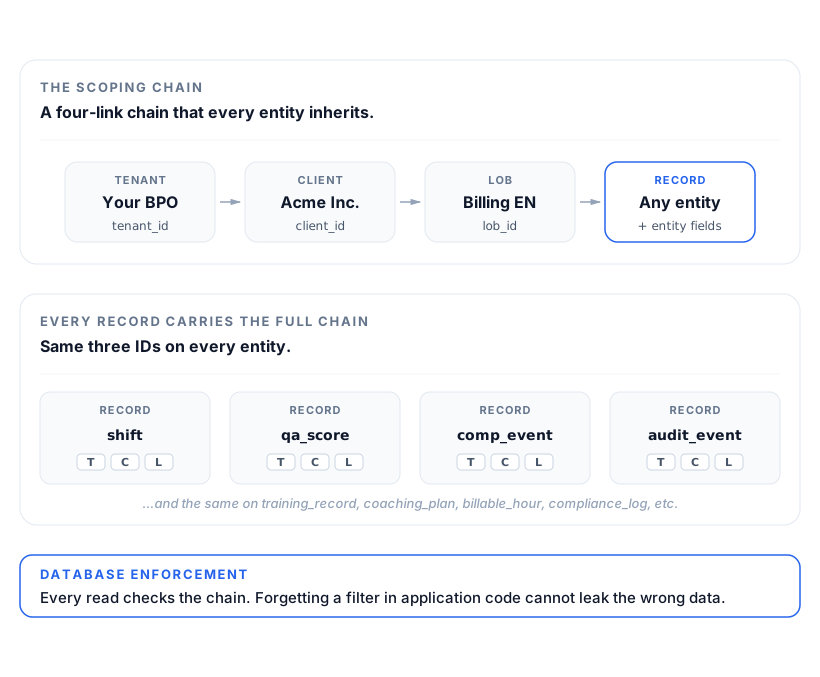
5. Combining data across clients and LOBs is a single operation, not an integration project. If a supervisor asks "show me every agent who is scheduled for Client B tomorrow, has the new product training certified, hasn't exceeded their weekly hours cap, and is permitted under Client B's PCI scoping," the platform answers it directly. There is no overnight batch process. No CSV export. No reconciliation meeting. The question is a single read.
6. Client portal access is structurally guaranteed, not configured. When a client logs into the portal to see their own scorecards, schedules, and performance, the system literally cannot return data from a different client. The guarantee comes from the data model's enforcement layer, not from a UI that filters on the way out. This matters because clients audit it, and because "we filter in the application" is the line a vendor offers right before the breach.
These six are the architectural posture. They are not features that can be added later. A platform that did not start with all six will not get to all six by adding them, because each of them constrains every other one. The QA scorecard's binding to a client is the same data path as the schedule's binding to an LOB is the same data path as the compliance record's binding to a regulatory regime. Build the path once, build it correctly, and everything that needs to use it inherits the guarantee. When modules get integrated after the fact, the path ends up built five different ways across five different modules, and the guarantee disappears at every join.
Six diagnostic questions for buyers
The six questions below are diagnostics. Each one tests whether a platform's underlying model handles a structural BPO requirement, or whether it papers over the requirement with a custom field, a workaround, or an integration. Run them on every vendor presentation. Generic platforms fail at least four. The ones that pass all six are worth a deeper conversation.
1. Can one of my agents legitimately be assigned to two of my client accounts in your native data model, with different supervisors, different comp rates, and different SLA scorecards, without any of those being a custom field, a tag, or a workaround?
This is the test the rest of the questions depend on. If the platform can't represent "one agent, two concurrent client jobs" as a structural fact, every cascade in this article happens to you. A vendor demoing two separate agent records (one per client) or showing "Client" as a custom field with application-layer filtering is giving the same wrong answer in two different costumes.
2. If I ask you "how many billable agent-hours did each of my clients owe me this period?", is that a single query against your platform, or does it require pulling data from multiple tools and joining it manually?
Billing reconciliation is the gap between booked and collected revenue. A platform that requires multi-tool reconciliation creates the gap continuously and asks you to plug it manually every cycle. "Our reports module can export the breakdown to CSV" is the polite version of "we can't do it; the join happens in Excel, by a person."
3. If Client A's contract requires data residency in Canada under PIPEDA, and Client B's contract is fine with US-hosted under CCPA, can your system honour both for the same shared agent's records, or does the most restrictive client's policy apply to everything?
BPOs that adopt "most restrictive across all clients" pay for compliance overhead they don't owe. BPOs that don't, run risk they can't quantify. There is no third option without per-client compliance scoping. "We're SOC 2 Type II for the whole tenant" is an answer to a different question; that's the platform's posture, not per-client enforcement.
4. Can you generate a schedule that respects every multi-LOB agent's eligibility constraints (language, certification, client permission, weekly hours cap) in one operation, or does the scheduler operate against the aggregate and require manual adjustment afterward?
This determines whether Tuesday morning is a healthy day or one where Client B's bilingual queue is understaffed while Client A's English queue has seven idle agents. The platform either decomposes demand correctly at scheduling time or it doesn't. A scheduler that hits 90 % accuracy on the volume forecast but loses ten minutes per agent per shift on manual re-routing is failing this question in a way that doesn't show up on its own dashboards.
5. When my Client A logs into the portal to see their scorecards and schedules, what stops Client B's data from showing up: application code that runs a filter on every screen, or a structural enforcement at the database that doesn't depend on the application getting it right?
Clients ask this in their security reviews. If the answer is "application code filters it," they'll either reject the platform or impose a separate-tenant workaround that costs you license fees and a parallel reconciliation process. "We use role-based access control" is a non-answer; that by itself doesn't solve client-level isolation. The right answer involves the database itself refusing to return the wrong rows.
6. If the same agent takes calls for three of my clients, can your QA module apply each client's specific scorecard to their respective calls, and roll the results up per agent across all three scorecards, without my evaluators running parallel processes in a second tool?
The official QA score is what supervisors coach against, what clients see in QBRs, and what HR uses for performance reviews. If it's structurally incomplete because the platform can only apply one scorecard per evaluation, every downstream decision is calibrated to the wrong baseline. "Scorecard templates are configurable per LOB" is the half-answer to watch for: yes, but can you apply more than one to the same agent's body of work, and can a coach see them all together in a single view?
A platform that fails four of the six can still be the right purchase, if you understand which four and what the workaround cost is going to be. The point of the questions isn't to disqualify vendors. It's to make the structural picture visible before the contract is signed, instead of after.
The point
If you've read this far and recognized your own operation in five of the six cascades, you don't need anyone to tell you the multi-client architecture problem is real. You've been living inside it for years. What may be new is the name, and the realization that the workarounds, reconciliations, and quiet margin leaks aren't sins of operational hygiene. They are the visible consequences of a structural mismatch between the software you bought and the kind of company you actually run.
The point of this essay is the question, not any one answer to it. Take the six diagnostic questions into your next vendor evaluation. Take them into your next RFP and your next QBR with the platform you've already bought. Some get answered crisply. Others get redirected to product roadmaps. The ones that get the word "configurable" applied like a bandage are the ones to pay closest attention to. The pattern of the answers will tell you more about how that platform is actually going to behave in your operation than any feature comparison spreadsheet.
We're building FrontLine because, after thirty years of watching this problem fail to get solved by adding integrations on top of single-employer software, we think the only fix is to start the data model over with multi-client architecture as the first decision. Whether FrontLine is the right purchase for any specific BPO is a separate conversation. This essay isn't an attempt to sell it. It's an attempt to give the industry a name for a problem that has been costing BPOs money in five places at once for thirty years, and a set of tests that make the problem visible before the next contract is signed.
If you'd like to compare notes on whether the architecture argument lands for your operation, on what the questions surface in your stack, or on what the Atlas covers, send me a note. I read everything that comes in.
Sources
The figures cited in this essay are drawn from published industry benchmarks. Where the full report is gated, the link points to the publisher's own landing page so the methodology is verifiable.
Attrition. ContactBabel, US Contact Center Decision-Makers' Guide, 2024 . Annual benchmark on US contact-center attrition, agent metrics, and operating costs. Sponsor-distributed full PDF available via RingCentral .
Cost per hire. SHRM, Talent Acquisition Benchmarking Report . SHRM's own summary of the $4,129 average cost-per-hire benchmark; the full report is members-only.
Contract value leakage. World Commerce & Contracting, Poor contract management continues to cost companies 9% of their bottom line . WorldCC's own research summary of the ~9% value-leakage figure across industries.
Forecast accuracy. ICMI, Guide to Contact Center Metrics (full PDF, hosted by co-author Brad Cleveland). Includes the forecast accuracy benchmark band of under 5% best-in-class and 5–15% typical.
Knowledge retention. Panopto, Workplace Knowledge and Productivity Report . Source of the $47M-per-year knowledge-loss estimate, the 42% individual-held-knowledge figure, and the 81% experience-based-knowledge stat.
Integration tax. MuleSoft, Connectivity Benchmark Report . MuleSoft's official benchmark landing page; the 2024 edition documents the $4.7M average annual integration spend and the 39% IT-time figure.
All other figures in the essay, the $3,500–$7,500 replacement-cost band for contact-center roles, the $200K–$400K reconciliation-FTE estimate for a 1,000-agent BPO, the LMS, WFM, and QA cost ranges, are conservative estimates based on the figures above combined with industry-typical fully-loaded labour rates. Where a figure is an estimate rather than a published benchmark, the essay flags it as such.
Serge Belov
Founder, FrontLine
Founder of FrontLine and a thirty-year contact centre solution architect. He has built and run the systems behind multi-client operations, and started FrontLine to put the whole operation, hire to retire, on one platform.