The Disputed Evaluation: What Happens to Trust When QA Gets It Wrong
An agent who knows their 74% is wrong, with no clean way to challenge it, learns one thing fast: the scoreboard is rigged, so why try. Treat the dispute as a transparent, time-boxed protocol instead of a bureaucratic annoyance, and fairness becomes one of the cheapest retention levers a BPO has.

Dawna Barlow
Operational Excellence Consultant · Published June 8, 2026
Ask a seasoned contact centre supervisor what derails an agent's motivation faster than a rude customer, and you'll get the same answer every time: a low QA (Quality Assurance: the program that scores and reviews agent interactions.) score they didn't deserve. It plays out the same way. An agent navigates a legacy database, de-escalates a furious caller, and solves the problem. Two days later, a 74% lands on their dashboard. They were docked for a compliance phrasing technicality that didn't apply, or the evaluator missed that they verified the account in the first thirty seconds. The agent disputes it. At that exact crossroad, most BPO (Business Process Outsourcing: a firm that runs contact-centre operations on behalf of other brands.)s make an operational mistake: they treat the dispute as an administrative annoyance to be minimized or quietly buried in a workflow. But an unfair evaluation costs far more than a missed coaching moment. It teaches the agent that the entire quality program is theatre, and when agents decide the scoreboard is rigged, they stop trying. Fixing the dispute process isn't a concession to the floor; it's one of the most underused retention levers you have.
The true cost of a fumbled dispute
When an agent gets a score they know is wrong and has no transparent, friction-free way to challenge it, the damage doesn't stay contained to one scorecard. It ripples across the operation.
Quiet quitting. If scoring feels arbitrary, agents stop aiming for excellence and start gaming the scorecard — doing exactly enough to pass instead of solving the customer's problem. You don't lose them in one dramatic exit; you lose their discretionary effort, quietly, weeks before they leave.
The supervisor bottleneck. When the process is opaque, supervisors become defence attorneys for their teams: re-listening to the same audio, arguing with analysts over email, playing telephone between QA and the floor. That is hours a week of your most experienced people spent litigating instead of coaching.
Eroded trust. Trust takes months to build and seconds to break. The moment an agent decides the system is fundamentally unfair, their investment in the company drops — and in an industry that already runs on thin tenure, a broken QA process is a direct line to an exit interview.
The moment an agent decides the scoreboard is rigged, you've stopped measuring performance and started funding an exit interview.
Transparency by default: show the agent what the auditor saw
You cannot ask an agent to trust a score when all they see is a final number and a few generic bullet points. Real transparency means handing the agent and the supervisor the same artifacts the evaluator used. If the interaction was scored against a screen recording, the agent should be able to watch their own screen playback synced to the audio. If a timestamp is cited for a miss, that timestamp should link straight to the media player at that second.
When an agent can see exactly what the evaluator saw, a large share of disputes evaporate before anyone files one, because most disputes aren't really about the score. They're about the gap between what the agent remembers doing and what the scorecard claims happened. Close that gap with evidence and the argument never starts.
The blind second-evaluation
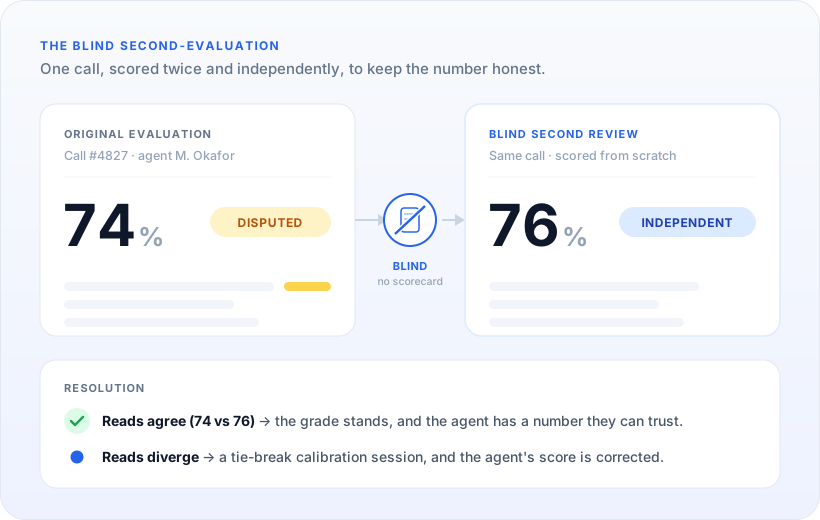
When an agent or supervisor formally disputes a line item, the worst move is to send it back to the original evaluator to "double-check their work." Human nature guarantees the answer: the auditor defends the call they already made. Route formal disputes to a blind second review instead.
Reassign the call. It goes to a different analyst or a QA calibration lead, never the original evaluator.
Strip the context. The second reviewer gets the raw interaction file with no original scorecard and no prior notes, and scores it clean from scratch.
Reconcile the two reads. If the scores agree, the grade stands and the supervisor now has rock-solid evidence to coach from. If they diverge, the case goes to a tie-breaking calibration session, the agent's score is corrected, and you have just caught a real alignment gap between two of your own evaluators — worth far more than the single score it resolved.
Put a clock on it
A dispute that sits in an inbox for two weeks is a toxic asset. While the ticket is open, the agent is anxious and checked out, and the coaching the evaluation was supposed to produce is frozen in place. Treat dispute resolution with the same discipline you apply to a client SLA (Service Level Agreement: a contractual performance target, e.g. answering X% of calls within Y seconds.): a hard, published clock with a named owner at every stage.
| Stage | Owner | Clock |
|---|---|---|
| Dispute logged | Agent or supervisor | T0 |
| Blind second-review complete | QA analyst / calibration lead | Within 24 hrs |
| Final resolution + score update | QA lead + supervisor | Within 48 hrs |
A published 48-hour window does something policy language never will: it proves to the frontline that management treats their performance record — and their peace of mind — with the same seriousness it treats a client's service level. The deadline is the message.
From gotcha to growth
Stand up a dispute process that is transparent and genuinely objective, and the culture of the floor shifts in a way that is easy to underestimate. Agents start engaging with their quality metrics instead of bracing against them. The weekly QA result stops being a verdict to fear and becomes a diagnostic they can use. The QA team stops being the floor police out to catch mistakes and becomes what it was meant to be: an impartial third party whose read agents trust precisely because they have watched it correct itself when it was wrong.
That's the same shift that turns QA from a policing function into a retention lever in the first place, and it's nearly free. Fairness is one of the cheapest retention strategies a BPO operations lead has, and almost nobody funds the dispute workflow that delivers it. Build one that honestly protects the integrity of an agent's performance record, and you're not defending a metric. You're keeping a trained agent from deciding the game is rigged and leaving to play somewhere else.
Dawna Barlow
Operational Excellence Consultant
Has spent years on contact centre floors across quality, training and coaching, operations, and compliance: the full span of running a contact-centre program, not just one corner of it.