Scoring French Calls with an English Scorecard: Bilingual QA Done Honestly
Grade a high-velocity French call off a rigid English rubric, then hand the coaching back in English, and you quietly punish your most fluent agents for sounding French. Split the corporate scorecard from the agent's coaching, and bilingual QA stops being a fudge. It starts paying you back in retention and CSAT.

Dawna Barlow
Operational Excellence Consultant · Published June 17, 2026
If you run a contact centre in Canada, you know the bilingual compromise by heart. Your client sits in Toronto or New York, the master quality and compliance framework is written entirely in English, and a big share of your volume comes out of Quebec. So a bilingual evaluator puts on a headset, listens to a fast French call, and grades it in real time against an English rubric. Then the whole review happens in English too, right down to the coaching notes the agent reads, even though they spent the entire call in French. Usually that's down to a tight client timeline or a platform that won't bend. It feels efficient. It quietly rots the floor. Bilingual quality really comes down to two questions: can your evaluators judge what the agent actually said, in the language they said it? And do your French-speaking agents get feedback they can actually use? Here is where most programs fudge both, and how to build one that holds.
The translation fallacy: when an English metric doesn't mean the same thing in French
Whether you are working from a translated scorecard or just staring at the English form while a French call plays in your ear, the trap is the same: you assume an English corporate metric means the same thing in French. It almost never does.
Take a line item like "demonstrated active listening and empathy." In an English shop, empathy gets scored on predictable verbal tells: "I can certainly help you with that," or "I completely understand how frustrating this is." So an evaluator on an English scorecard listens for the French versions of those exact phrases. French doesn't work that way.
A Quebec agent builds real rapport through pacing, warmth, and a reassuring « Parfait, on va regarder ça ensemble », and never once says the textbook empathy line the rubric is hunting for. The connection lands. The checkbox stays empty.
So the auditor, head down in the English rubric, dings one of your sharpest, most culturally fluent agents. Not for failing the customer, but for connecting in French instead of reciting an English script. You have built a machine that rewards imitation and quietly taxes the real thing.
An English rubric pointed at a French call doesn't measure how well the agent served the customer. It measures how well they imitated an English script.
Three ways fudged bilingual QA (Quality Assurance: the program that scores and reviews agent interactions.) breaks the floor
Run untranslated English forms, deliver the feedback in English too, and the cracks show up fast, in the same three places every time.
The real-time cognitive load. The auditor follows a fast French call while translating it in their head, reading the intent, and hunting for the English checkbox that fits, call after call after call. By mid-afternoon the scoring drifts. The same call earns 86% in the morning and 78% after lunch, and no one can say what changed except the clock.
The feedback void. An agent works a high-stress billing dispute entirely in French: calms a furious customer, de-escalates clean, all in their first language. Two days later the QA form lands: 82%, every note on it written in English. Even a fully bilingual agent finds that jarring. Improving your French tone from English coaching notes is confusing, it stalls people, and it quietly breeds resentment on the floor.
The calibration mirage. In the weekly alignment session, the English ops team and the bilingual QA team stare at the same English scorecard and walk out sure they agree. They don't. They have calibrated the words on the page, not the sounds on the line. And that agreement evaporates the second an analyst is back on a headset with a French call in their ear.
The fix: decouple the scorecard from the coaching
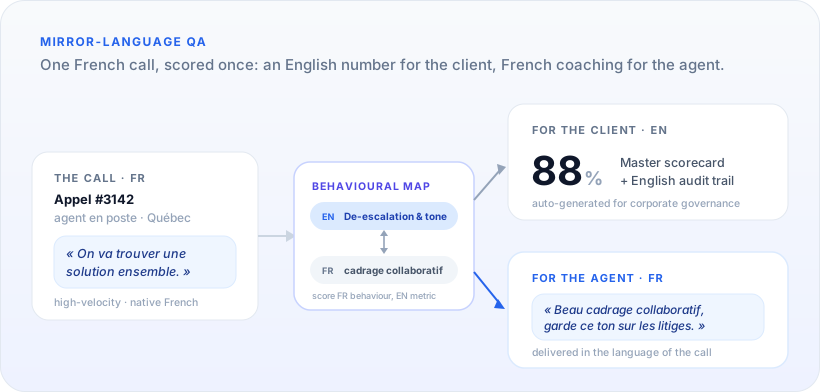
You can build bilingual QA that actually holds up, even when the client won't budge on an English master scorecard. The trick is to stop making one document do two jobs: the corporate record and the agent's coaching. Pull them apart. The number can speak English for the client and for corporate; the coaching has to speak whatever language the call happened in. Three moves get you there.
Step 1: Build a behavioural map
If the scorecard has to stay in English for the client, don't leave the interpreting to whoever happens to be evaluating that day. Build a behavioural map underneath every English metric, one that spells out, in plain terms, what the behaviour looks like in each language. It is the bridge that lets an evaluator score French honestly without touching a line of the client's framework.
| Master metric (English) | What it looks like in English | What it looks like in French |
|---|---|---|
| Active listening & empathy | Verbal acknowledgements: "I can certainly help with that," "I understand how frustrating this is." | Localized warmth and pacing, like « Parfait, on va regarder ça ensemble », with a reassuring tone over scripted phrasing. |
| Effective de-escalation & tone | Soft transitions, avoids defensive phrasing, like "What I can do is…" | Collaborative framing, like « On va trouver une solution », staying warm without cold, bureaucratic distancing (« C'est le règlement »). |
Now the auditor isn't translating on the fly and guessing. They are matching what they hear to written, language-specific evidence. Calibration error drops, because everyone is grading against the same definition of good, in both languages.
Step 2: Coach in the language of the call
The rule is short: coach in the language of the call. If it happened in French, the agent reads about their French gaps in French. Full stop.
The metric titles on screen can stay English to keep the master system happy. Fine. But the actual feedback gets written in the language the call was handled in. If the client needs English documentation for audit, let translation or text-expansion tools generate the corporate-facing copy on the back end. What the agent reads, the dashboard and the coaching conversation, stays French.
The number speaks English for the client. The coaching speaks French for the agent, because French is where the work happened.
Step 3: Calibrate by language, not around it
Stop running one giant calibration where the team grades an English call and a French call back to back against the same criteria. That is the mirage again. Split them, and calibrate each language on its own.
Let your bilingual team leads fight about the cultural weight of the actual phrasing. Is « C'est le règlement » cold and bureaucratic here, or just appropriately firm? Then carry those calls back to the master scorecard numbers. Now you are calibrating the sounds on the line, not the words on the page.
The edge that doesn't translate
Serving the Canadian market means working in a genuinely different culture, not a translated version of the American one. Treat French as a box to tick on a translated Word doc, or ignore it outright on an English form and hand the feedback back in English, and you shortchange your agents and your client at once.
Build bilingual QA where the evaluation and the coaching both respect the language that was actually spoken, and two numbers you report on every month start to move. Floor retention climbs, because agents feel heard and fairly judged. It's the same shift that turns QA from a gotcha into a retention lever. And Quebec CSAT (Customer Satisfaction: a post-interaction score for how satisfied a customer was.) climbs, because your agents are free to sound like people instead of a translated script. Done honestly, bilingual quality stops being the compromise you put up with and becomes the one edge your English-only competitors can't copy.
Dawna Barlow
Operational Excellence Consultant
Has spent years on contact centre floors across quality, training and coaching, operations, and compliance: the full span of running a contact-centre program, not just one corner of it.