Seven Reasons Your HR App Breaks in a Multi-Client Contact Centre
Generic HR software is built on one quiet assumption: one company, one workforce, one set of rules. The moment you take on a second client, that assumption starts to crack, and it keeps cracking as you add the tenth. Here are seven of the cracks, and why none of them show up in the demo.

Serge Belov
Founder, FrontLine · Published August 14, 2026
Generic HR software is built on one quiet assumption: one company, one workforce, one set of rules. For most of the market that is a fair assumption. For you it is the wrong one.
The moment you take on a second client, that assumption starts to crack, and it keeps cracking as you add the third and the tenth. None of the cracks show up in the demo, because the demo only ever shows one client. They show up later: in a billing dispute, a scheduling conflict, a margin you cannot explain. Here are seven of them, roughly in the order they start to hurt.
1. It assumes one company. You run twenty.
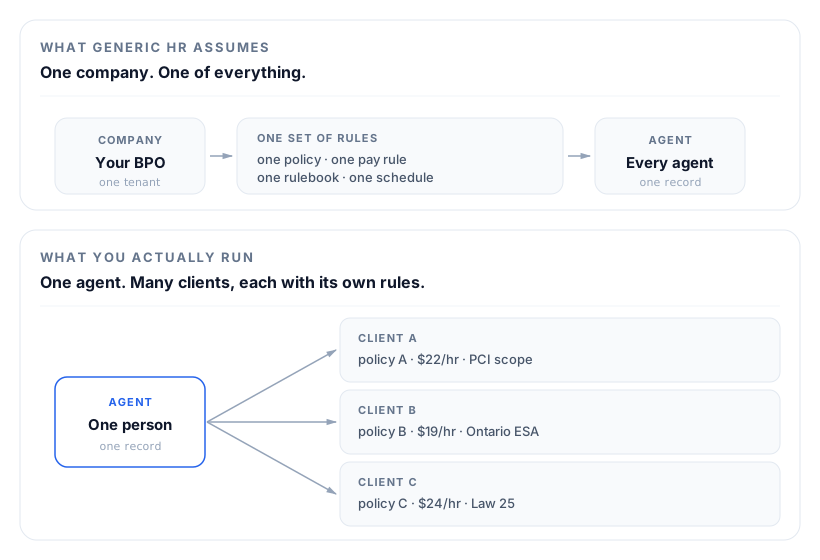
Every field, every policy, every report in a generic HR app hangs off a single employer. One handbook. One org chart. One set of pay rules. In a multi-client centre an agent lives inside several of those at once: this client's attendance policy, that client's overtime rule, a third client's holiday calendar. The tool has one slot for each, so you settle on a global default and track the exceptions in someone's head or a spreadsheet. The exceptions are where the mistakes live.
2. There is no wall between clients.
One employer means one permission hierarchy. That is fine until Client A's competitor is Client B and both are on your floor. A generic HR app can hide fields with roles and configuration, but it cannot give you a structural guarantee that one client's data can never reach another, or that a client logging into a portal can only ever see their own people. In a business you win and keep on trust, "we filter it in the application and we are careful" is not the same promise as "the database will not return the other client's rows." The difference is exactly the one your prospect's security team asks about.
3. It cannot tell you which client makes money.
Blended margin hides your problem accounts. A generic HR app holds labour cost, but it does not tie that cost to a client and a line of business, so real profit per client is a spreadsheet you build after the quarter closes, if you build it at all. You find out an account was underwater when finance finally reconciles it, which is exactly too late to do anything about the rate. The hidden cost of running clients in separate tools puts numbers on how much this quietly costs.
4. The roster you billed is unreproducible.
The record you actually invoice and pay against is not the employment record. It is the roster: which client each agent was assigned to, at what rate, on which day. That record lives between your HR app and your WFM (Workforce Management: forecasting, scheduling, and adherence.) tool, and neither versions it properly. So when a reassignment gets backdated after an invoice has already run, the basis for that invoice quietly changes, and you can no longer show the version you billed from. Your HRIS remembers salaries. Can it remember the roster you billed? is the long version of why this one is worse than it sounds.
5. One agent, two clients, a schedule it does not understand.
Cross-training is how you keep good agents busy across accounts. But if concurrent client assignment is not a first-class idea in the system, the same agent can be booked for Client A's Monday peak and Client B's Monday training in the same hour, and nothing catches it until someone calls out. The conflict surfaces as an SLA (Service Level Agreement: a contractual performance target, e.g. answering X% of calls within Y seconds.) miss or a backfill at overtime rates, and it surfaces on the floor, not in the tool.
6. Compliance is per-jurisdiction and per-client, not global.
Rest periods, overtime caps, and break rules vary by province, state, and country, and in a nearshore or multi-country operation an agent's rules depend on where they sit. On top of that, individual clients carry their own regimes: a payments client drags PCI scope onto the agents who touch their work, a health client brings its own privacy requirements. A single global rule set gets at least one of these wrong, and "wrong" here means a labour complaint or a failed client audit.
7. Reporting rolls up or slices down, not both.
You need two views of the same data. The COO needs a roll-up across every client to run the business. Each client needs a slice-down to just their program for the quarterly review. A generic HR app assumes one dimensional model, so you get one of those cleanly and rebuild the other by hand every reporting cycle. The hand-built one is the one that is wrong the week you are too busy to check it.
Two more, once you feel them
A couple that belong on the list the moment they start to cost you. Skills and eligibility that are not scoped per client, so "who is actually cleared to take this client's calls today" lives in tribal knowledge rather than in the record. And onboarding that treats a 150-agent ramp for a new client as an ordinary batch, when it is really a project with that client's checks, certifications, equipment, and access attached to it.
The through-line
The pattern in all of these is the same. Generic HR software is not bad software. It is software built for a company that has one of everything, sold to an operator who has many of everything. The gaps are not bugs. They are the assumption showing through.
FrontLine is built the other way around. Every record is scoped to tenant, client, and line of business, enforced in the database rather than in application code someone can forget to check. Assignment history is effective-dated. Cost ties back to the client. The audit trail is immutable. It is not that FrontLine is the only HR system with a memory or a permission model. It is that the multi-client case is the starting assumption here instead of the edge case. The Atlas is the fastest way to see what that looks like across the whole platform.
If you run one client, a generic HR app is fine. If you run many, the question is not whether these gaps exist in your stack. It is which one bites you next.
Serge Belov
Founder, FrontLine
Founder of FrontLine and a thirty-year contact centre solution architect. He has built and run the systems behind multi-client operations, and started FrontLine to put the whole operation, hire to retire, on one platform.