Starter · Part of Workforce Management
Labour Compliance
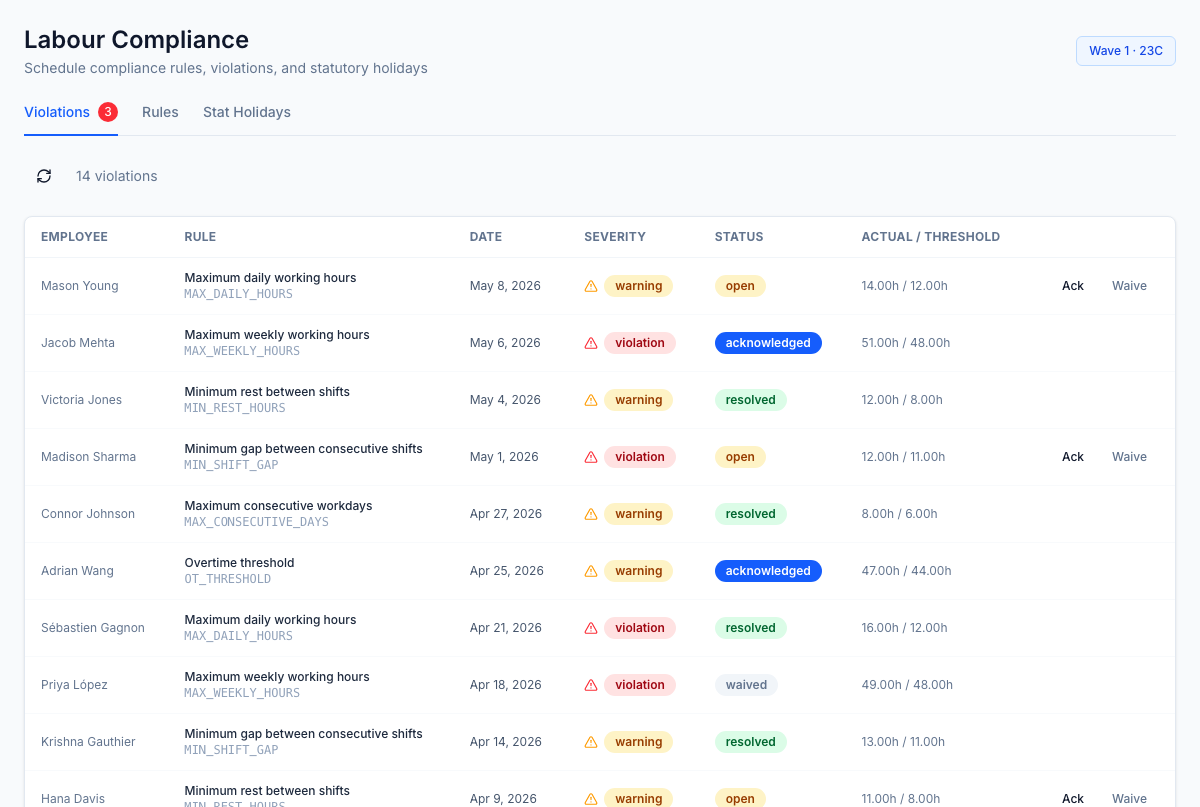
Provincial rest-period, overtime, and meal-break rules enforced at schedule-creation time. Your scheduler can't accidentally publish a 14-hour shift; HR isn't reading legislation to catch infractions after the fact.
For the operator
Compliance rules are configured once at the jurisdiction level — rest periods, max consecutive shifts, meal-break thresholds, daily and weekly hours caps — and every shift mutation runs through the validator before it persists. A scheduler trying to publish a non-compliant grid sees the violation inline with the offending shift, not in a Friday-afternoon HR escalation. The same gate fires on shift swaps, bidding awards, and intraday OT — every path that creates or moves work, not just the planner's manual edits.
Business impact
Labour-board penalties land in the five-figure range per infraction, but the bigger exposure is the class-action posture if a pattern emerges across a site or LOB (Line of Business: a distinct client program or queue within an operation.). Enforcing compliance at the point of mutation makes the violation impossible rather than detectable-after-the-fact, removing the recurring legal-defence cost line entirely. It also lets you bid on regulated-vertical clients (healthcare, finance) without having to staff a dedicated compliance role to ride herd on the schedule.