Starter · Part of Workforce Management
Shift assignment with overlap + rest-period validation
The scheduler can't double-book an agent, can't violate their rest period, and can't ignore timezone. The system catches it at assignment time, not after the agent shows up at 6am for the wrong shift.
For the operator
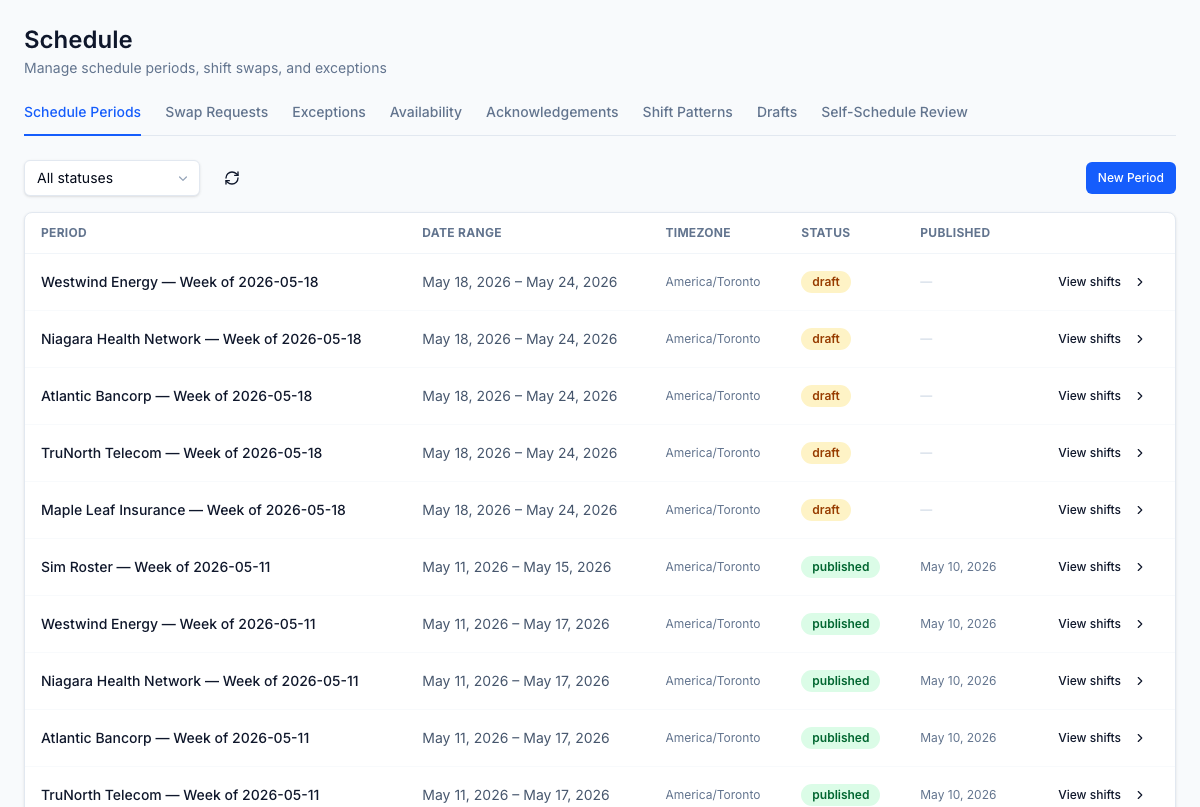
When a scheduler manually assigns or moves a shift, the system runs three simultaneous checks before persisting: no overlap with the agent's existing shifts, no rest-period violation with the surrounding shifts, and timezone-aware boundary handling for cross-DST or multi-site agents. The validator surfaces the specific failing rule inline, not as a generic error, so the planner can either fix the constraint or override with a documented reason. Mistakes that used to surface at 6am Monday when the agent showed up to the wrong shift surface at 11am Friday at the planner's desk.
Business impact
Schedule errors at point of assignment are cheap to fix; the same errors at point of execution are expensive — the missed shift, the angry agent, the SLA (Service Level Agreement: a contractual performance target, e.g. answering X% of calls within Y seconds.) dip, the supervisor escalation. Catching them upstream with deterministic rules rather than human attentiveness eliminates a class of operational cost that doesn't appear on a P&L (Profit and loss: the statement of a business's revenue and costs.) line but consistently drains supervisor capacity and triggers preventable attrition events.