Growth · Part of CSAT
Survey templates and metrics
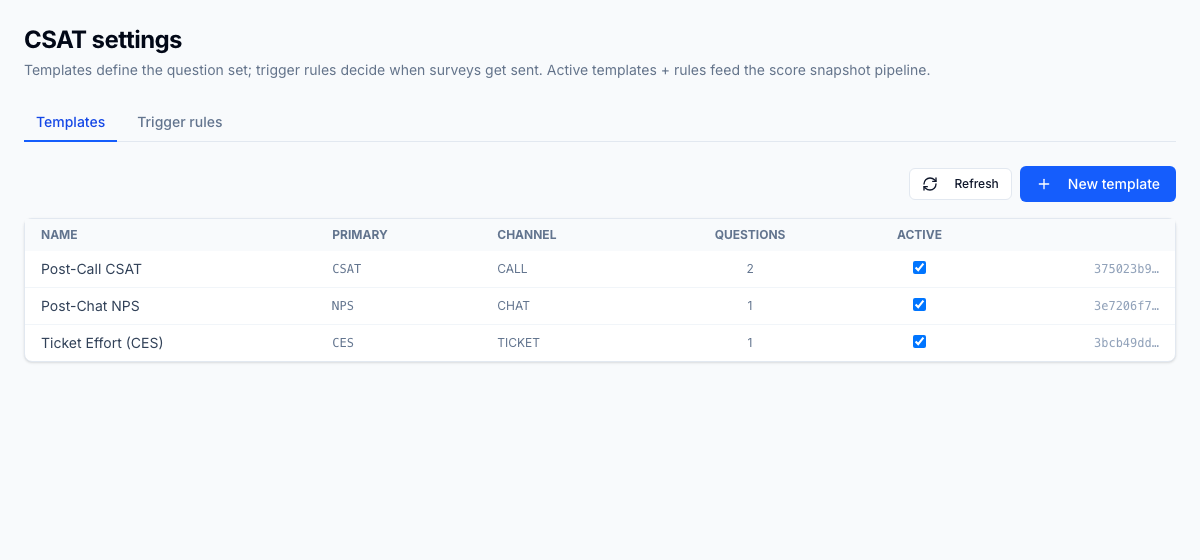
Survey templates let you define how each post-interaction survey measures satisfaction. Every template carries one primary metric: NPS (Net Promoter Score: how likely a customer is to recommend the brand.), CSAT (Customer Satisfaction: a post-interaction score for how satisfied a customer was.) (5-point), CSAT-10 (10-point), CES, or binary, plus an optional open-text verbatim question and per-question scale overrides. Two share flags control whether the agent name is shown to the customer and whether verbatims flow through to the client portal, and everything is built and edited under Settings > CSAT.
For the operator
You open Settings > CSAT and create a template, then pick its primary metric from NPS, CSAT (5-point), CSAT-10 (10-point), CES, or binary. You add an optional open-text question when you want verbatim comments back, and you override the scale on individual questions where the default does not fit. Two toggles sit on the template: one shows or hides the agent name to the customer, the other decides whether verbatims are shared into the client portal. Because you can build more than one template, a WFM (Workforce Management: forecasting, scheduling, and adherence.) analyst can keep a 10-point CSAT-10 survey for one program and a simple binary thumbs-up for another. Edits apply to new surveys going forward, so you tune wording and scales without rebuilding from scratch.
Business impact
Different clients ask for satisfaction on different scales, and templates let you match each one: NPS for a brand that reports Net Promoter, CSAT-10 for a program that wants a wider scale, CES for an effort-focused contract. The agent-name share flag lets you honor client and privacy preferences on what the customer sees, while the verbatim share flag controls exactly which open-text comments reach a client's portal view. Because the metric and scale are set per template, the numbers you defend in a client review match the instrument that client agreed to. The scores and verbatims collected stay in the same platform as your QA (Quality Assurance: the program that scores and reviews agent interactions.) and coaching, so a supervisor coaches from real customer feedback without exporting to a separate survey vendor. That keeps satisfaction measurement inside the same platform that already carries the client and LOB (Line of Business: a distinct client program or queue within an operation.) attribution your reporting depends on.